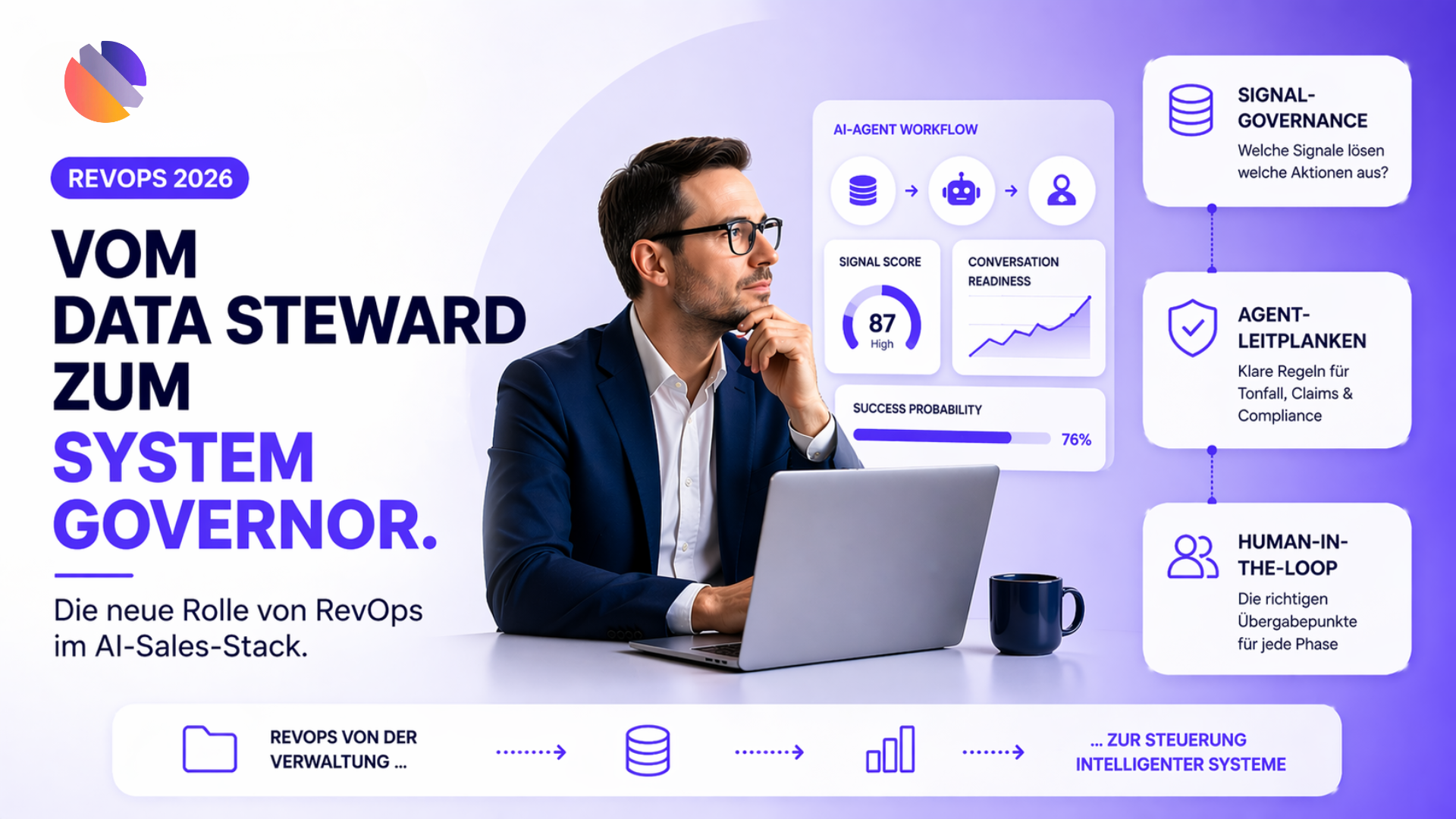
When AI agents take over the operational work of selling, the role of RevOps shifts. Data maintenance gives way to governing intelligent systems.
In B2B sales, who makes which decision is shifting quietly but fundamentally. Until two years ago, RevOps mainly made sure the numbers were right, the pipelines were clean and the tools talked to each other. In 2026 a new dimension is added: governing intelligent systems that make decisions and trigger actions on their own.
Gartner predicts that by 2028 around 75 percent of routine RevOps tasks in workflow management, data maintenance, revenue analytics and RevTech administration will be taken over by AI agents. When agents do the operational work, the strategic layer stays with people. RevOps thereby becomes the authority that defines the rules the system operates by.
The Old Role as Data Steward
The classic RevOps function emerged because sales, marketing and customer success worked in separate systems with different definitions of lead, opportunity and account. RevOps brought these systems together, harmonized processes and defined reporting logic. Daily work consisted of data cleansing, CRM field structures, routing rules and dashboards.
This work was valuable, but largely reactive. It is no longer enough once AI agents trigger actions on their own. An agent that prioritizes leads, a model that determines outreach timing, a system that sends follow-ups: every component makes decisions that previously belonged to people, and needs an authority that defines its rules.
The New Role as Governor of Intelligent Systems
With agent-based systems in the GTM stack, the focus shifts from managing static data to governing dynamic systems that continuously learn and act. A system governor defines which signals count as buying indicators, which data sources a scoring model may trust, and where an agent can act autonomously or has to involve a human. Organizationally, the role thereby moves closer to compliance and product management than to classic reporting.
Decision Area: Signal Governance
AI agents are only as good as the data they access. When an agent prioritizes a lead or triggers a campaign, someone must have decided beforehand that the underlying signal is meaningful. Signal governance means building a hierarchy among data sources, because a website visit has a different reliability than a LinkedIn engagement or first-party data from the CRM.
This includes regularly checking which signals actually correlate with closed deals and which only generate activity. Without this governance layer, signal automation quickly turns into a scaled form of wasted reach.
Decision Area: Agent Guardrails
An agent that writes messages needs clear limits for tone, product claims, salutation and regional compliance. These guardrails cannot be set once during onboarding, they have to be adjusted continuously, because models, markets and products change. RevOps mediates here between marketing, sales, legal and engineering.
What matters is which actions an agent executes on its own and which it delegates back. An agent may, for example, automatically send a follow-up when the lead score is below a threshold and the last interaction is more than seven days ago, and escalate to the responsible SDR when something deviates. Such rules belong in a documented, audit-proof system.
Decision Area: Human in the Loop
The strategically most important task is the deliberate design of the interface between agent and human. Full automation sounds efficient, but it can become expensive in sensitive phases, because a poorly worded message to an enterprise prospect costs more than the minutes saved. Human in the loop means defining handover points where the human steps in wherever their judgment delivers genuine added value.
What Comes Before Governance
Despite all this care, one question remains open: is what goes into the system even correct? No matter how precisely an agent prioritizes, if the underlying assumptions are wrong or the right lead goes to the wrong sender, automation amplifies the error. This is exactly where DealEngine comes in as a conversation readiness platform, ahead of the classic funnel and the RevOps orchestration.
The decisive lever is a different matching logic: instead of merely scoring a lead and handing it to the next available sender, lead, sender and message are matched together. Signal governance, agent guardrails and human in the loop only unfold their value once they sit on a foundation of conversation-ready leads.