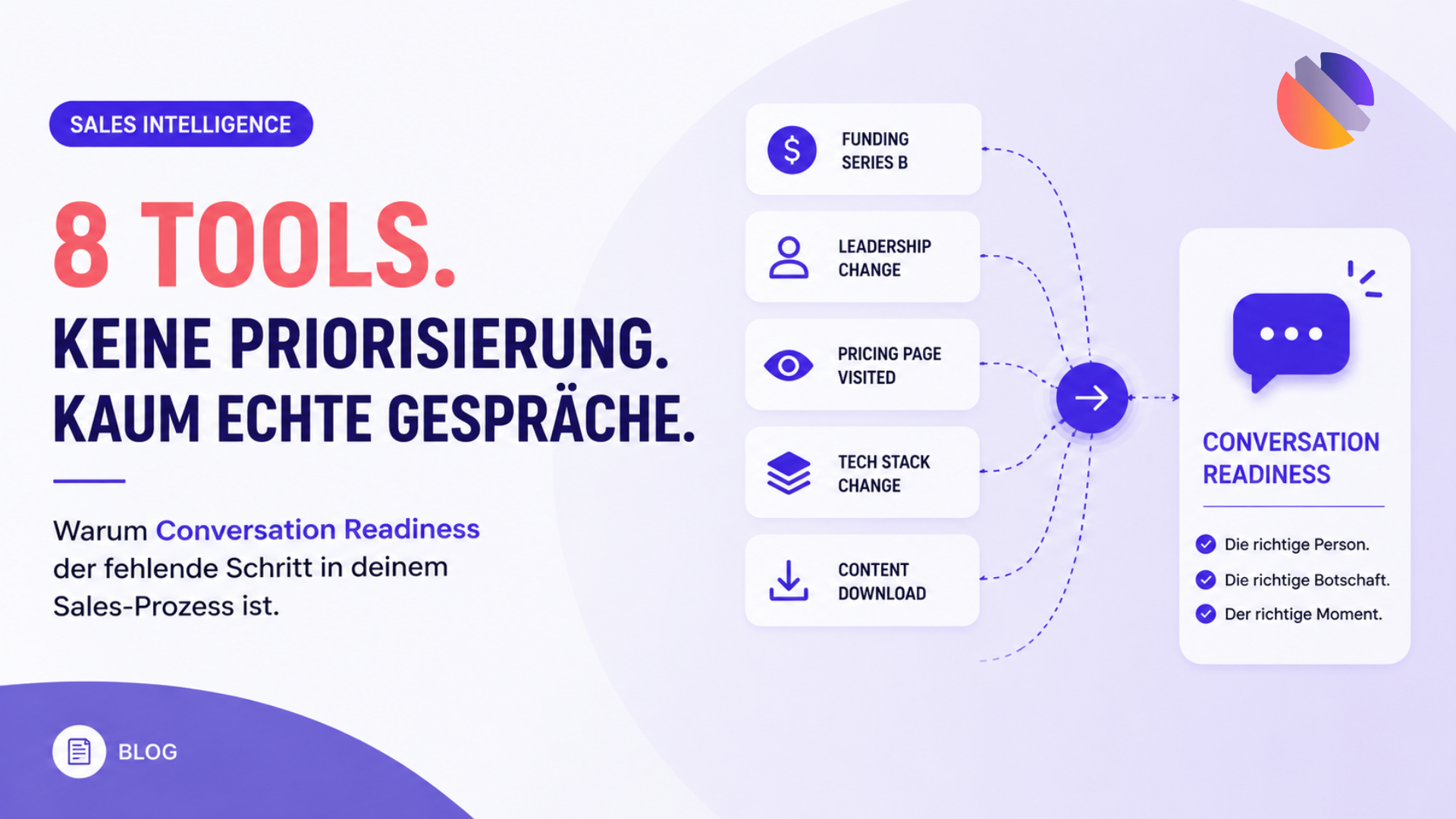
B2B sales teams do not have a signal problem, they have a translation problem. Anyone who mistakes signal density for conversation readiness ends up collecting data instead of reasons to talk.
B2B revenue teams have more information about their target accounts today than ever before. Funding rounds, leadership changes, tech-stack switches, content downloads, pricing-page visits and hiring signals are available at any moment. And yet reply rates keep falling, deal cycles grow longer, and the number of activities per booked meeting keeps rising. The reason is not a lack of data, it is fragmentation.
According to Salesforce, sales reps work with eight different tools on average, and a large share feel overwhelmed by this landscape. Each system sees only a slice: the CRM knows the contact history, the marketing tool knows the engagement, the intent provider knows the topic research. No single system sees the full picture. This is exactly where signal stacking fails as a sales strategy.
Why Signal Stacking Alone Does Not Work
Several stacked buying signals convert statistically better than a single one. In practice, though, teams buy intent data, filter by surge scores and load the results into generic sequences, while the reply rate stays stuck at three to five percent. The mistake lies in confusing signal density with conversation readiness.
An account may have closed a funding round, posted three sales openings and visited the pricing page all at once. Without context, those remain three data points and not a reason to talk. Signal stacking answers whether something is happening, but not whether an account is ready for a conversation right now.
What Sets Conversation Readiness Apart From Intent
Intent measures activity, conversation readiness measures the ability to have a conversation. Intent data says that an account is researching a relevant topic. Conversation readiness says that a specific contact, based on their role, their behavior and the timing, is ready for a concrete message, sent by a fitting sender through the fitting channel.
Teams that work signal-based and with contextualized messages reach reply rates of 15 to 25 percent instead of the usual three to five percent. These results do not come from more signals, but from translating signals into reasons to talk in the right way.
The Translation Problem Between Signal and Conversation
Between a recognized buying signal and a relevant conversation lies a translation step with three dimensions. First, context enrichment: who visited the pricing page, is this a decision-maker or a researcher, were there earlier touchpoints. Second, sender matching, because who sends a message is just as decisive as its content. Third, timing and channel, because a quickly contacted web lead qualifies far more often, provided the channel fits the context.
Most stacks cover context enrichment halfway, ignore sender matching, and leave timing and channel to the intuition of individual reps. That is the core of the translation problem.
A Workflow From Signal to Message
A viable process first consolidates four to seven signal sources into a single view, instead of constantly adding new sources. The signals are then scored on three dimensions: fit to the ideal customer profile, engagement, and recency, because a surge score that is six weeks old is historical noise. Based on this scoring, the decision is made whether and, above all, by whom an account is contacted.
The message is not built from a template, but from the concrete signal context. Finally, a feedback loop closes the process: which signals convert into meetings, which sender-lead combinations work. The best teams review this data monthly and adjust their scoring weights accordingly.
Where DealEngine Comes In
DealEngine is neither another signal source nor another scoring tool, it solves the translation problem between signal and conversation. The platform consolidates existing signals, scores them on conversation readiness rather than intent alone, and derives from that which contact should be approached by which sender, with which message, through which channel.
At its core is psychological matching, the insight that sales is an interaction between two people in their respective roles. The result is less activity, more relevance, shorter cycles, and teams that know in the morning whom they are calling and why.